

The aim of this project is to restore a 1980 Yamaha XT500 G to a good, road-legal standard in Italy, and to get the grin back on my face. It started as something much smaller, and (spoiler) it grew.
What I set out to do with the XT500
At first the plan was modest: get it running, find an original tank, restore the seat and deal with the rust. As time passed I quickly realised that wasn’t going to cut the mustard. To get it registered in Italy I needed to do more. So the aim changed: make it look at least a bit closer to a 1980 model, tackle the extensive corrosion, and get it registered for road use.
I wasn’t attempting a 100% nuts and bolts restoration. I just wanted the grin back.
European or Australian XT500? Choosing the colour scheme
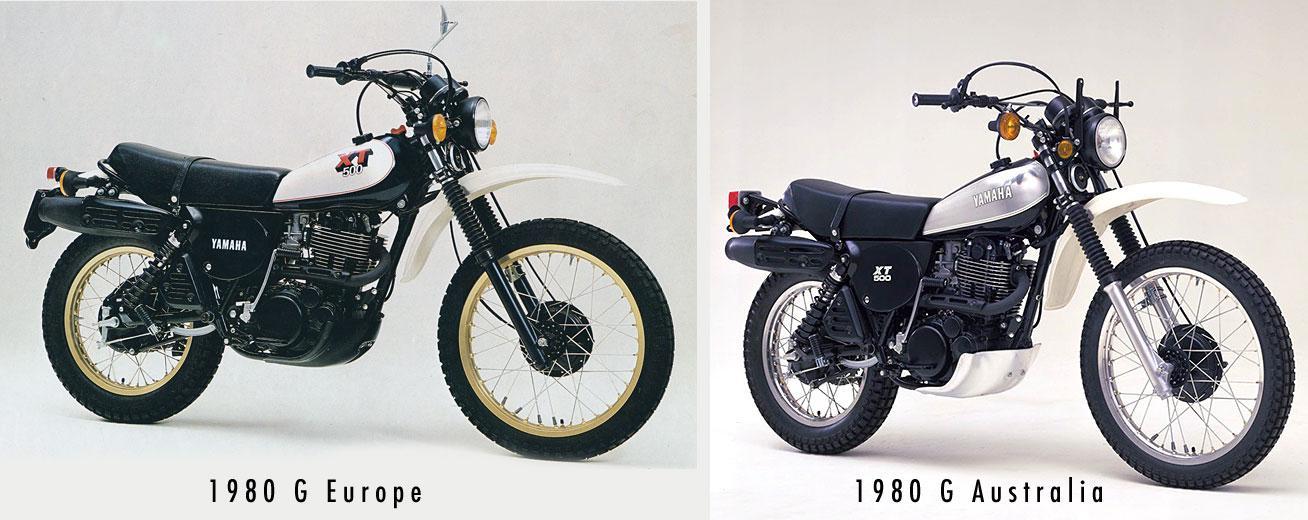
My aim changed again when research (and the TT500 XT500 forum) showed me that the European and Australian models had different colour schemes, amongst other things. Until then I was convinced I had the wrong wheel rim colour, and an expense I wasn’t convinced I should take.
No worries, though. I decided on the original Australia, USA, Canada and South Africa styling of “New Yamaha Black”, rather than the European version with its white tank, black bash plate and gold wheel rims. (The UK version appeared in the 1981 James Bond film “For Your Eyes Only”, with added machine guns. Mine will have to manage without.)
That meant I could use the wheels and bash plate I already had.
What does 3H7 mean on an XT500?
More about the model details later. My frame and engine numbers match and begin with 3H7, which was for Australia and Canada. The US version started with 3H6 and looked basically the same, with a few slight changes.
12V conversion and the deadline I missed
I also aimed to convert to 12V and electronic ignition, replacing the 6V contact points and some really poor lights. I set myself a target of spring 2021 at the latest, which would be 32 years after I first bought the bike, when it will be 41 years old. I was reaching that deadline as I first wrote this, and I still hadn’t finished. In the end the rebuild was completed in August 2021, and then came the paperwork. The bike wasn’t registered until March 2022, which is a story in itself.
XT500 spares I already had
- OEM cam timing chain, new and still in its packaging
- Speedo cable guide, but missing the rubber damper
- OEM oil dipstick
- OEM front indicators (handlebar mounted)
- 1980 forks, bought on Subito (€280 plus €20 shipping)
Where to start: my initial XT500 restoration plan
- Update my tool kit and buy some of the specialist tools to make life easier.
- Get it running first to confirm the oil is circulating, then drain it while hot.
- Dismantle it completely so the frame and parts can be powder coated.
- Clean up and powder coat or paint the yokes, clocks and all brackets.
- Clean the carb and check it internally.
- Inspect the valves, cylinder and top end, repair or replace any worn parts, and hone or re-bore if necessary.
- I was quite confident the gears and bottom end were fine, so I didn’t expect to split the crankcases.
- Paint the engine after the cylinder and top end are assembled (I wasn’t sure whether to powder coat it).
- Fit Rex’s Speed Shop 12V conversion, electronic ignition kit and battery. Wiring and electrics are my least favourite part of this project.
- Skip the indicators unless they’re a legal requirement in Italy. I’m quite happy using my arms, as I always have.
- Find a 1980 aluminium tank that’s not too damaged, then repair it and paint it if it’s in the wrong colours.
- Buy new seat foam and cover.
- Clean up the front mudguard and side panels, and maybe source black side panels.
- Replace the tyres and inner tubes (the front tube has a very slow puncture, in a tubeless tyre).
- Remove the BSM logo from the tail pipe and repaint it.
- Fit a chain guide or case saver around the front drive sprocket.
- Replace the drive chain and sprockets. Change from 17/42 to 16/43 and fit the case saver. The standard ratio is 16/42.
- The 1976 inner mudguard is a mess and needs repairing or replacing with a 1980 version.
- Repaint the rear mudguard and search for a rectangular tail light to replace the circular one.
My first XT500 parts order
- 12V kit from Rex’s Speed Shop
- Rubber cap for fork top nut 21036, 1 piece
- Chain slider swing arm (ring)
- Aluminium chain guide (case saver)
- Chain guard/chain case (large type)
- Mounting kit for OEM XT500 chain guard item
- Rear fender extension (aka inner mudguard)
- Replica rear reflector, red, round, 55mm
- Rubber pad at outer fork tube (cable guide), OEM
- Front brake lever, black, OEM
- Chain tensioner block, round top
- Screws for seat mounting brackets, OEM
- Seat mounting set (seat to frame, Allen screws M8)
- Rubber damper side cover lock
- Rubber dampers for tacho/speedometer
- Engine oil valve (stop valve)
- Bracket for rear indicators
- Indicators, fit front and rear, ‘E’-marked, black
- Rubber grommets, cap for rear indicator thread
- Front fork top yoke screw
- Screws for meter bracket
- Replica front fender, ‘Clean White’
- Air filter, OEM reference # 583-14451-00
- NGK spark plugs BP7ES
- Air filter oil, 1000ml
- Gasket for oil sump, OEM reference # 583-13414-00
- Gasket, left crankcase/generator cover, OEM
- Gasket, right crankcase/clutch cover
- O-ring (e.g. oil filter cover, intake valve cover)
- Seat strap bolts, stainless steel, chrome
Frequently asked questions
What colour is the Australian Yamaha XT500?
The Australia, USA, Canada and South Africa models used “New Yamaha Black”. The European version had a white tank, black bash plate and gold wheel rims.
What does 3H7 mean on a Yamaha XT500?
It’s the prefix of the frame and engine number for the Australia and Canada models. The US version began with 3H6.
How long did the XT500 restoration take?
The project began in May 2020 and the rebuild was completed in August 2021. Registration took until March 2022.
What is being changed on this XT500?
The main jobs are dealing with the corrosion, converting from 6V points to a 12V electronic ignition, fitting a correct 1980 tank, a new seat and a new chain and sprockets (16/43, with a case saver), and getting it registered for road use in Italy.
