

This site documents the restoration of a Yamaha XT500 G 1980, an Australian-market model that has lived in Australia, the UK and Italy. The project began in May 2020 as a Covid-19 lockdown job, back when we all had a lot of time and a worrying amount of enthusiasm. Most of it has been written in hindsight. I made several mistakes and wrong assumptions along the way, which I’ve quietly ironed out to spare my embarrassment. They’re documented elsewhere, though, should you wish to rub my nose in it 🙂

Got a question about anything you read here? Come and find me on the XT500 TT500 Forum, where there’s a friendly bunch who know far more than I do (and will happily tell you so).
Yamaha XT500 G (3H7) at a glance
- Model: Yamaha XT500 G, 1980 Australian market
- Manufactured: November 1979
- Engine/frame number: 3H7-001310
- Engine: standard 499cc
- Chassis: Hagon shocks, a one-off custom tank and seat, and a BSM after-market exhaust
- Mileage at the start of the project: 76908 km
- Journey: bought in Melbourne, imported to the UK in 1990, then ridden to Italy in 2004
- Restoration started: May 2020
Melbourne, 1989: buying a 1977 Yamaha XT500 from Yamaha City
Ancient history, the short version:
The 1977 XT500 came with lots of after-market parts already fitted, including a butt-ugly, no-brand plastic tank. I then bought a second XT500 (a 1980 model) privately, as a non-runner, to be a donor for spares.
As it turns out, that plan got turned on its head. According to some recently discovered documents, it was the frame and engine from the second bike that I ended up keeping.
In those days I shot only transparency film, so I’ll have to dig through my boxes of slides and add them here as and when I find a way to scan them. Here’s one to be going on with:
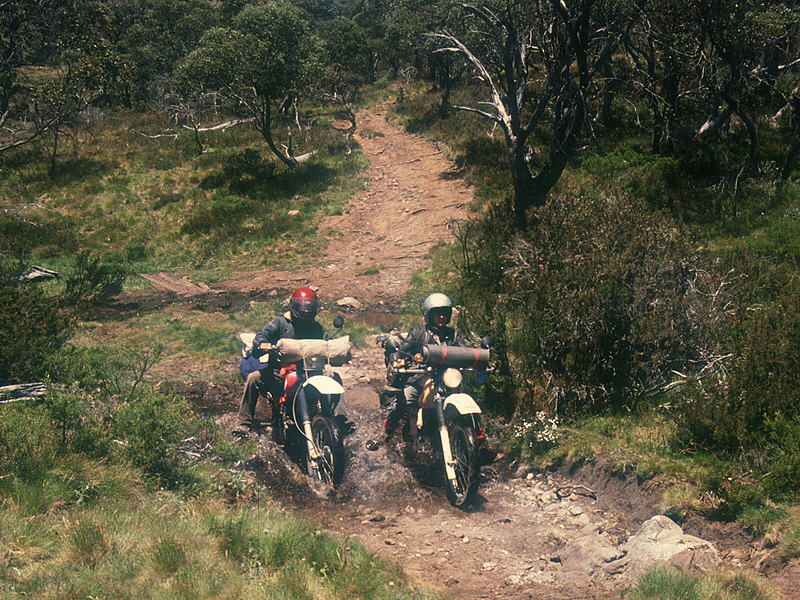
Building one XT500 from two, for the Australian outback
I combined the two bikes, choosing the better-condition parts where I could. The engine and frame numbers ended up matching by luck rather than design. The result was an XT500 for travelling in the outback and the bush. I must have sold, given away or forgotten about all the leftover parts. Cue the guilt.
Then there was the tank: a hideous, bulbous, sickly yellow plastic thing, 15 litres if memory serves. It developed a very slow leak around the (after-market) petcock seal. I repaired it again and again, and every time the leak crept back after a few hours or days, like a bad penny.
I had a great deal of fun, riding kilometres of dirt and dust, mountains, forests, deserts, beaches, the Blue Light Rally and the odd bit (1000’s of kms) of bitumen. There were many falls and many repairs along the way. Then my visa ran out and it was time to go home.
Shipping the XT500 from Melbourne to the UK
I considered selling the bike to pay for my flight home, but I had become too attached to it so instead I crated it up and shipped it from Port Melbourne to the UK. It arrived at Tilbury docks some months later, and I registered it on a Q plate. I think that was because I didn’t have a bill of sale showing the frame number or proof of manufacturing date, but at the time I didn’t care. I just wanted to ride it.
XT500 fuel tanks: a plastic regret and a stainless steel solution
At some point I chucked the plastic tank. Why oh why I didn’t hunt down an original one back then remains a mystery. It would have been a breeze compared with today, and a fraction of the cost. More on that later in fuel tank the fuel tank post.
I borrowed a custom aluminium long-range tank from a mate for a while. I also had an Eric Cheney XT500, which had an even smaller tank than the original. Eventually I commissioned a new tank, with the intention of making more long road trip adventures (they never really happened). The original petcock fits. It’s stainless steel rather than aluminium, mainly because of the price, but also because the chap who made it didn’t weld aluminium. Yes, it’s very heavy. Almost bullet-proof. And now for sale.
Riding the XT500 from Cornwall to Italy, 2004
In 2004, according to the last UK tax disc, I rode from Cornwall to Italy during a very, very hot summer. Somewhere around Stuttgart the engine died. I thought I’d run out of fuel, but no. Finding TDC again to restart it felt kind of stiff, but it eased up after a few turns. Overheated? Seized? I hoped not. I prayed. I sat in my self-inflicted leather sauna on the side of the autobahn for perhaps 20 minutes, checked the oil level, and got her going again after a few kicks. Tentatively, I carried on as far as Austria, where she stayed garaged with family until later in the year, when I came back to make the final leg to Italy.
Approaching the Reschen Pass it started to snow, thick, fast and sticky. The first snow of the season kept my visor wiper finger very busy for the next hour or so. I arrived in Val Venosta very wet and very cold, with an even colder and rather unimpressed wife sat behind me.
Storing a UK-registered XT500 in Italy
The bike has been garaged ever since, occasionally turned over and run up the lane. I never managed to get an Italian plate. One of the licensing agencies told me that importing a UK vehicle wasn’t possible because they drive on the other side of the road. (I am not kidding!) The last time I fired it up was in 2015: two kicks, full choke, then it idled at 1150 with no choke and a bit of smoke. The following photo was taken in 2010. From the odometer in another photo (not shown), it has done precisely 3 km since then.

I last tried to start it in 2016 and failed, although there was a spark. I drained all the petrol from the tank and carb, loosened the spark plug and left it stored. Since then it’s only been turned over very occasionally.
XT500 spares: the ones that got away
Over the years I picked up lots of spares and other XTs, and probably kept swapping parts around, especially once I had the Cheney. A non-runner was given to me once by someone who simply wanted it out of their Mum’s back yard (an impossible dream today). I sold the last of my spare engines and other spares around 2006 or 2007. Another regrettable impulse, as they’d come in very handy now.
Frequently asked questions
What model is this Yamaha XT500?
It’s a 1980 XT500 G (3H7) built for the Australian market, with engine and frame number 3H7-001310. It was manufactured in November 1979.
Where has this XT500 been?
It was bought in Melbourne in 1989 and used for outback and bush travel. It was shipped to the UK in 1990 and registered on a Q plate, then ridden from Cornwall to Italy in 2004.
Why restore it now?
After years in storage in Italy, the restoration began in May 2020 as a Covid-19 lockdown project. And in 2026 imported back to the UK, dismantled and transported in the back of my car.
